OEM numbers
Service numbers, casting marks, cross-references. Pulled from the part and the listing.
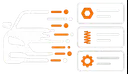
Every part listing gets a wiki page. OEM numbers, fitment notes, donor caveats, and matching inventory. No page yet? It builds in about 15 seconds.
The listing gets found. The wiki explains why it fits.
Open from inventory
This is the one wiki page that doesn't build itself. The rest do.
Service numbers, casting marks, cross-references. Pulled from the part and the listing.
What else it fits. Year, engine, platform. So buyers can compare before they ask.
No page yet? It generates the moment a buyer opens the part. About 15 seconds.
When a seller has one listed, the wiki points straight to it.
Built from the part
The wiki is built from the part itself. OEM data, fitment records, assembly relationships. Nobody starts at a blank page. Nobody maintains a second destination.
Every scanned part lands in the marketplace with a wiki link attached.
OEM numbers, fitment, donor caveats, matching listings. Pulled together in about 15 seconds, no blank page in sight.
Sellers add casting marks. Buyers confirm what worked after the install. Every page gets sharper over time.
What the page carries
Year, engine, trim, interchange. Attached to the part, not buried in a three-week-old message thread.
Part numbers, casting marks, service numbers. Something real to check before anyone sends a message.
Known swaps, missing pieces, donor differences, install gotchas. Right where the buying decision happens.
No more reading, switching tabs, and searching again. When a seller has one listed, the wiki points straight to it.
Real example
LS1 identification, donor differences, fitment caveats, confirmed applications, and the listings to buy from. Everything an LS swap shopper actually needs, in one place.
Open the real page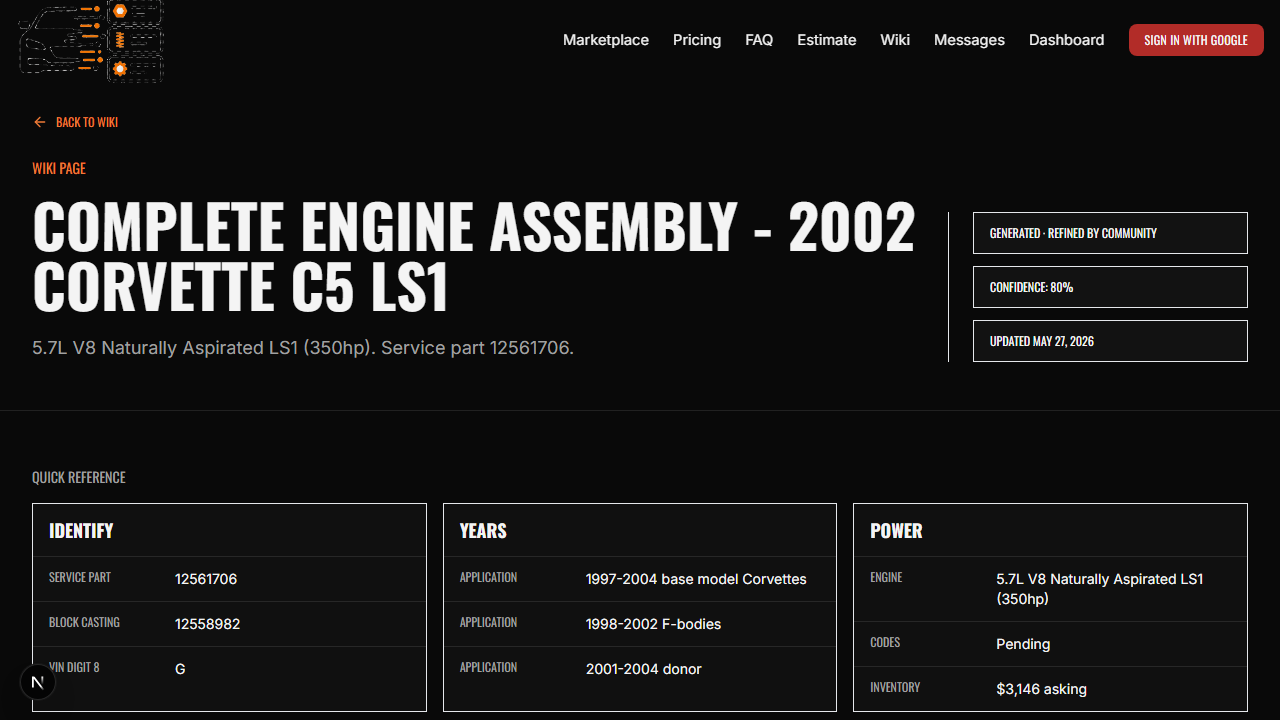
Every category here is the same one your listings, filters, and wiki pages use. One set of words. No translation between what the buyer searches and what the seller stocked.
Powertrain, drivetrain, chassis and brakes, electrical, lighting, body and glass, interior. Same names, every screen.
Engine & Powertrain
Engine assemblies and supporting systems.
Transmission & Driveline
Systems delivering power from engine to wheels.
Suspension & Steering
Ride control and steering components.
Brakes
Brake system components for stopping the vehicle.
Wheels & Tires
Rolling stock and related hardware.
Electrical & Wiring
Power distribution, wiring, and control modules.
Infotainment & Audio
Entertainment, navigation, and connectivity components.
Hybrid & EV Systems
High-voltage components specific to hybrid and electric vehicles.
Lighting & Signals
Illumination and signaling components.
Body & Sheet Metal
Exterior structural panels and closures that form the vehicle body.
Exterior Trim & Hardware
Non-structural exterior pieces that finish and seal the body.
Glass
Transparent surfaces for visibility and weather sealing.
Interior & Cabin
Components inside the passenger compartment.
Climate Control (HVAC)
Heating, ventilation, and air conditioning parts.